On this page
Why Does the Classic 25-Minute Pomodoro Fail Developers?What Does Research Say About Interruptions and Programming?The 50/10 Protocol for DevelopersHow Do You Handle Slack, Meetings, and Code Reviews?When Should You Ignore the Timer?How to Track Your Pomodoros as a DeveloperFrequently Asked QuestionsReady to Run Your First 50-Minute Pomodoro?The Pomodoro Technique works for developers, but the classic 25-minute interval usually doesn't. Programming front-loads a heavy setup cost: you spend the first 10 to 15 minutes rebuilding mental context before you write a single useful line. A 25-minute timer often rings right as that context finishes loading. The fix is a longer interval, not abandoning the method.
Think of it as a mental compile. You load the function, its callers, the invariant you're protecting, and the test you're about to write into working memory. Then a kitchen timer throws it all away.
This guide explains why the standard protocol fails programmers, what interruption research actually says, and how to run a 50/10 version that protects flow instead of breaking it.
Key Takeaways
- The classic 25-minute pomodoro often ends just as a developer finishes loading mental context, which is why so many programmers abandon the method.
- Gloria Mark's research at UC Irvine shows it takes an average of 23 minutes and 15 seconds to fully return to a task after an interruption.
- A 50-minute work interval with a 10-minute break keeps the Pomodoro Technique's structure while respecting a programmer's flow state.
- Slack, code review, and meetings belong in batched slots between pomodoros, never inside them.
- You can run the 50/10 protocol right now with this free Pomodoro timer, no signup required.

Why Does the Classic 25-Minute Pomodoro Fail Developers?
The classic 25/5 split fails developers because programming carries an unusually long warm-up cost. Parnin and Rugaber's research on interrupted programming tasks (2011) found developers typically need 10 to 15 minutes just to resume productive coding. Subtract that from 25 minutes and the timer leaves barely ten minutes of real work before the bell.
Francesco Cirillo created the Pomodoro Technique in the late 1980s while studying at university. For reading, writing essays, and administrative work, 25 minutes is a sensible unit. Those tasks have shallow context. You can put them down and pick them up almost anywhere.
Code is different. A programmer holds a stack of nested state in working memory: the data structure, the edge case, the half-finished refactor two files away. Psychologists call the resulting immersion flow, and Mihaly Csikszentmihalyi's research on the subject consistently found that flow needs long, uninterrupted stretches to appear at all.
So the standard interval creates a cruel loop. You spend fifteen minutes loading context, get ten minutes of flow, then a timer you set yourself destroys the state you just built. Many developers try the technique once, feel this friction, and conclude the whole method is broken. It isn't. The interval is. If you're new to the method itself, start with the complete guide to how the Pomodoro Technique works and then come back for the developer-specific tuning.
What Does Research Say About Interruptions and Programming?
Research is blunt on this point: interruptions cost far more than most schedules admit. Gloria Mark's studies at UC Irvine found it takes an average of 23 minutes and 15 seconds to fully return to a task after an interruption. For a developer, one ill-timed ping can erase half a work session.
The volume of interruptions makes this worse. The Microsoft Work Trend Index reported in 2025 that knowledge workers face roughly 275 interruptions per day, about one every two minutes during core hours. Programmers sit inside that storm while doing some of the most context-heavy work in the building.
Attention spans reflect the damage. ActivTrak's State of the Workplace report for 2026 measured the average focused work session at just 13 minutes and 7 seconds, down 9 percent from 2023. Against that baseline, even a clean 25-minute pomodoro is an achievement. A protected 50-minute one is a superpower.
There's also evidence that longer intervals fit how productive people actually work. DeskTime's 2014 study of its most productive users found the top 10 percent worked in 52-minute sessions with 17-minute breaks. When DeskTime re-ran the study in 2021, top performers had stretched further, to 112 minutes of work with 26-minute breaks. Nathaniel Kleitman's basic rest-activity cycle points the same direction: human alertness rises and falls in roughly 90-minute ultradian rhythms, not 25-minute ones.
None of this says short intervals are useless. It says the interval should match the cost of rebuilding context, and for programming that cost is high. If constant pings are your real bottleneck, read why you can't focus and how the interruption trap works before changing any timer settings.
The 50/10 Protocol for Developers
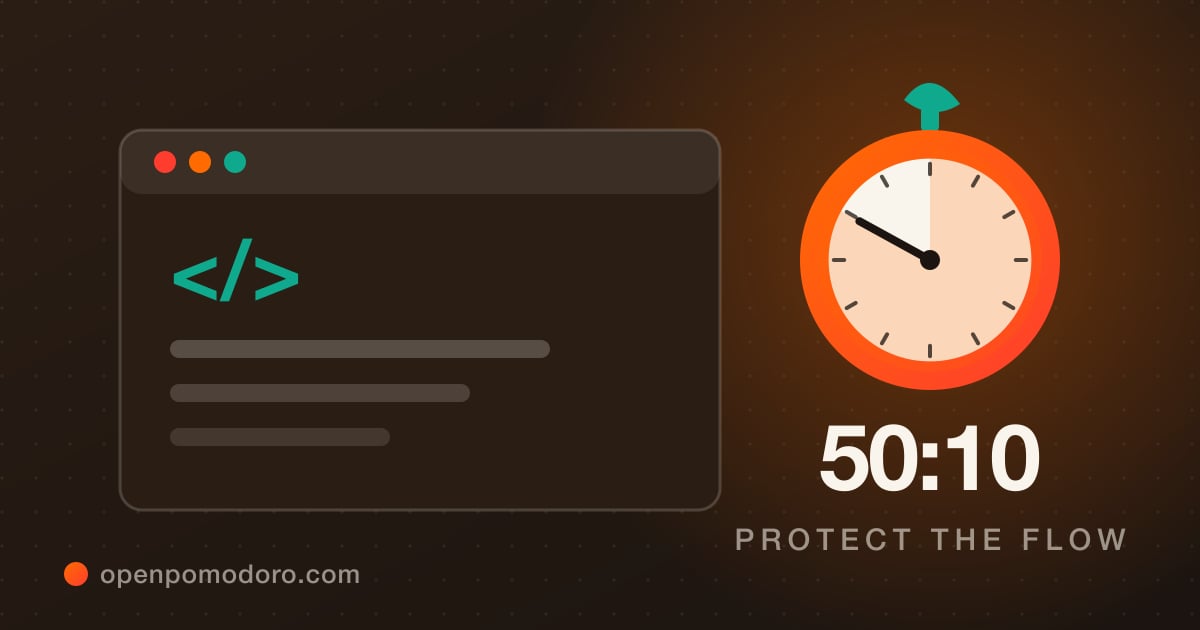
The 50/10 protocol keeps everything that makes the Pomodoro Technique effective, a hard start, a single task, and a real break, while doubling the interval to absorb programming's warm-up cost. It lands close to DeskTime's observed 52/17 pattern among top performers, and it divides cleanly into an hour, which makes calendar planning trivial.

Here's the full protocol, step by step:
- Define one verifiable outcome. Not "work on auth" but "the failing token-refresh test passes." If you can't phrase the task as something checkable, it's too vague to time.
- Start the timer before you open the editor. The context load is part of the work. Timing it keeps you honest about how expensive it really is.
- Handle interruptions with a rule, not willpower. Internal distractions ("I should check that dependency version") go on a paper list next to the keyboard. External interruptions either void the session or get a one-line note so you can resume fast.
- At the bell, land the plane. Finish the current thought, commit or stash, and write a one-line resume note describing exactly what comes next.
- Take a real break, off the screen. Ten minutes: stand up, get water, look out a window. No code, no Slack, no "quick" documentation reading. The break only restores attention if it's genuinely different from the work.
- Take a long break after three sessions. Three 50/10 rounds is about three hours of deep work. Follow it with 25 to 30 minutes fully away from the desk.
When I'm deep in a refactor, I write the resume note as a TODO comment directly at the cursor, so the next session starts exactly where the last one ended. That single habit cuts my restart time more than anything else I've tried.
If 50 minutes still feels short for your kind of work, you're not stuck. There's a whole family of Pomodoro interval variations, including 52/17 and 90-minute sessions, and the right one depends on your task depth and energy curve.
How Do You Handle Slack, Meetings, and Code Reviews?
Batch them between pomodoros and signal your status so nobody has to wonder where you went. With Microsoft's data showing an interruption roughly every two minutes during core hours, willpower alone can't win. You need structure that other people can see and predict, so the interruptions stop arriving in the first place.
For Slack, set a visible status before each session: "Heads down until :50, will reply then." Then actually reply at :50. The predictability matters more than the silence. Teammates tolerate a 50-minute response delay easily once they trust it's reliable, and most "urgent" questions resolve themselves in that window anyway.
Meetings deserve the same treatment as any other batch. Cluster them into one part of the day, usually the early afternoon energy dip, and defend at least one block of two to three pomodoros every morning. A calendar with six scattered 30-minute meetings destroys more engineering output than a single three-hour meeting block ever will.
Code review works best as its own dedicated pomodoro. Reviewing a pull request well requires the same context loading as writing code, so treat it with the same respect. Batch two or three PRs into one 50-minute session rather than sprinkling reviews between compile runs.
Finally, define what counts as a genuine emergency with your team. Production down qualifies. "Quick question about the ticket" does not. Writing that line down once saves the argument forever.
When Should You Ignore the Timer?
Ignore the bell when you're genuinely in flow and within a few minutes of a natural stopping point: a passing test, a compiling build, a completed thought. Csikszentmihalyi's flow research describes a state that's expensive to enter and cheap to lose. Trading real flow for timer obedience is a bad exchange, and the method's structure survives the occasional override.

Use a simple rule: finish the thought, extend by ten minutes at most, then take the full break anyway. The extension is a bounded exception, not an abandoned system. An unbounded "just five more minutes" loop is how developers end up bleary at 7 p.m. wondering where the afternoon went.
Watch the frequency, though. If you're overriding the bell every single day, the timer isn't the problem and neither are you. The interval is simply wrong for your work. Lengthen it deliberately rather than ignoring it habitually, because a rule you break daily stops shaping behavior at all.
Some work shouldn't be timed in the first place. Live incident response, pair programming with its own natural rhythm, and exploratory debugging of a bizarre production issue all resist fixed intervals. That's fine. The technique is a tool, not a religion. For an honest look at these boundaries, see when the Pomodoro Technique doesn't work.
How to Track Your Pomodoros as a Developer
Track two numbers per task: estimated pomodoros and actual pomodoros. Over a few weeks, that pair becomes a personal velocity metric more honest than story points, because it measures focused time rather than calendar time. A "two-day" ticket that took four clean sessions tells you something a sprint board never will.
Estimating in pomodoros also improves how you slice work. With 50-minute sessions, any task estimated above five pomodoros is really a project wearing a ticket costume. Split it. The act of asking "how many focused sessions will this take?" forces the decomposition that vague hour-based estimates let you skip.
Review your log weekly and look for two signals. First, your daily capacity: most developers sustain three to five deep-work hours, which maps to four to six 50/10 sessions on a good day. Planning for eight is planning to fail. Second, your estimate accuracy: if tasks consistently run 50 percent over, pad future estimates by that ratio instead of promising harder.
Keep the tooling boring. A text file, a note in the ticket, or your timer's built-in history is plenty. In my experience, the moment tracking takes more than ten seconds per session, it quietly stops happening by Thursday.
Frequently Asked Questions
Is the classic 25-minute pomodoro ever right for developers?
Yes, in specific situations. Shallow tasks like clearing email, writing standup notes, or updating tickets fit 25 minutes well. It's also a good procrastination breaker: committing to one short session is easier than committing to an hour. Use 25/5 for shallow work and low-energy days, and 50/10 for anything requiring real context.
What if my team expects instant Slack replies?
Make your latency explicit instead of silent. A status like "Focused until :50, will respond then" turns an unexplained absence into a predictable contract. Since you check messages between every session, your worst-case response time is about 50 minutes. Most teams accept that easily once they see it applied consistently, especially when your output visibly improves.
Should meetings count as pomodoros?
No. A pomodoro is a unit of focused, self-directed work on one task, and meetings are neither self-directed nor single-task. Track them separately if you track them at all. What matters is protecting enough non-meeting time for four or more clean sessions, because that's where your actual engineering output comes from.
What should I do during the 10-minute break?
Get away from every screen. Stand, stretch, refill water, look at something far away. Your brain keeps processing the problem in the background, which is why solutions so often appear mid-break. Checking Slack or reading documentation isn't a break; it just swaps one form of screen load for another and returns you tired.
Does the Pomodoro Technique work with pair programming?
Surprisingly well, and it's one place the classic 25-minute interval shines. Use the bell as the driver-navigator swap signal: one person types for a session, then roles switch after the break. Pairing has a built-in interruption resistance since two people hold the context, so shorter intervals cost less than they do solo.
How many pomodoros can a developer realistically complete per day?
Four to six 50/10 sessions, which is roughly three and a half to five hours of deep work. That matches what attention research suggests is sustainable, and it's far above the 13-minute average focus session ActivTrak measured in 2026. Fill the remaining hours with meetings, review, and shallow tasks without guilt.
Ready to Run Your First 50-Minute Pomodoro?
Pick one task from today's list and phrase it as a verifiable outcome. Set a 50-minute work interval and a 10-minute break. Put your status up, silence notifications, and start the timer before you open the editor.
One honest session will tell you more than any article can. Run it now with the free timer at openpomodoro's Pomodoro timer. Adjust the intervals in the settings, track your sessions, and find the rhythm that lets your mental compile finish before the bell rings.
Put this article into practice
Run your next focus session with our free online Pomodoro timer. No signup, fully adjustable intervals, works right in your browser.