The Pomodoro Technique: A Complete Research-Backed Guide
The Pomodoro Technique uses 25-minute intervals to beat procrastination. Learn the proven science, key variations, and how to start — 2025 RCT data included.
In 2025, the average knowledge worker's focused work session lasted just 13 minutes and 7 seconds — down 9% from 2023, according to ActivTrak's State of the Workplace 2026 report. The Pomodoro Technique was built precisely for a world that can't stop interrupting itself. It's a time management method that divides work into fixed 25-minute intervals, separated by short breaks, to protect attention before it erodes.
This guide covers everything: the history, the step-by-step method, the peer-reviewed science, the best variations for different work styles, and the honest limits of the technique. If you want to skip straight to practicing, the openpomodoro timer is free, requires no account, and works in any browser.
Key Takeaways
- The Pomodoro Technique structures work into 25-minute intervals followed by 5-minute breaks, with a longer 15-30 minute break after every four cycles.
- In 2025, workers average just 13 min 7 sec of focused work per session (ActivTrak, 2026), making structured intervals more relevant than ever.
- A 2025 RCT found no significant productivity difference between Pomodoro and unstructured work, but Pomodoro users reported faster fatigue — making variation selection important.
- The technique's real value isn't the 25-minute number; it's the psychological contract of committing to one task until the timer rings.
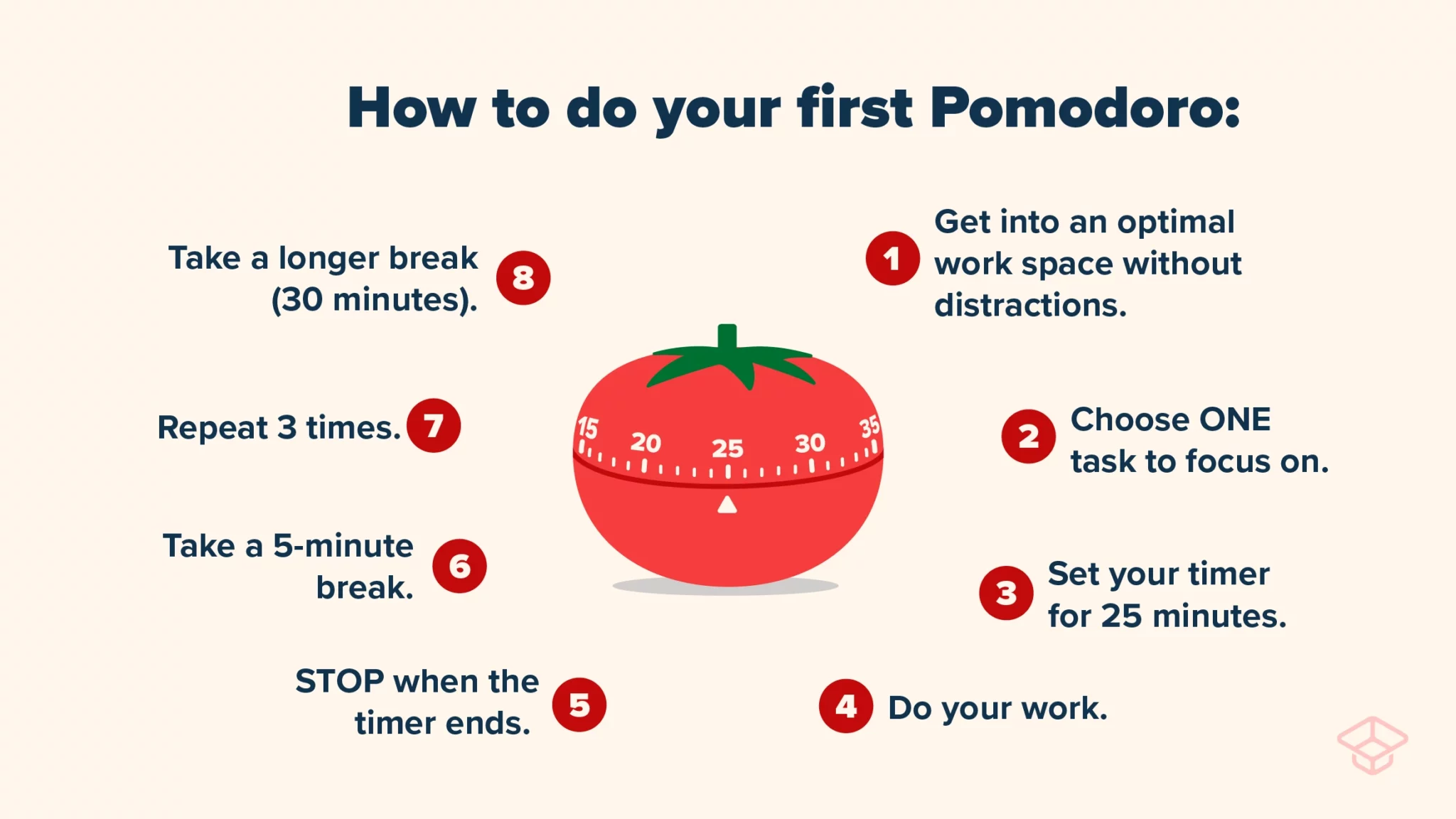
Table of Contents
- What Is the Pomodoro Technique?
- How Did the Pomodoro Technique Start?
- How Does the Pomodoro Technique Work?
- What Does the Science Actually Say?
- Which Pomodoro Variation Fits Your Work Style?
- When Does the Pomodoro Technique Not Work?
- Advanced: Combining Pomodoro with Deep Work Theory
- How to Start Using the Pomodoro Technique Today
- Continue Learning
- Frequently Asked Questions
What Is the Pomodoro Technique?
The Pomodoro Technique is a time management method in which you work on a single task for 25 minutes, then take a 5-minute break, and repeat. After completing four of these cycles — called "Pomodoros" — you take a longer rest of 15 to 30 minutes. The name comes from the Italian word for tomato: its creator used a tomato-shaped kitchen timer.
The technique has three defining properties that separate it from general "time blocking." First, it's interval-based: the time box is fixed and non-negotiable during the session. Second, it's single-task: no context switching once the timer starts. Third, it's iterative: you track how many Pomodoros a task takes, which makes future planning more accurate over time.
What the technique is not is a rigid law. The 25-minute interval is a starting point, not a prescription. The method's inventor made this clear in the original 1992 booklet, and the modifications explored later in this guide reflect that.
The core components:
- One Pomodoro = 25 minutes of focused, single-task work
- Short break = 5 minutes (mandatory, not optional)
- Long break = 15-30 minutes after every 4 Pomodoros
- Task list = planned before starting; each task gets an estimated Pomodoro count
[INTERNAL-LINK: five common mistakes with the Pomodoro Technique → article on common Pomodoro errors and how to fix them]
How Did the Pomodoro Technique Start?

Francesco Cirillo developed the Pomodoro Technique in the late 1980s while studying at the Università degli Studi di Roma. Struggling to concentrate during university, he made a bet with himself: could he study for just 10 minutes without distraction? He grabbed a tomato-shaped kitchen timer from his apartment, set it, and the method took shape over the following weeks as he refined the intervals.
Cirillo published the technique in a 1992 booklet titled The Pomodoro Technique — the full text of which he later made available for free. The method spread slowly through developer and productivity communities in the 2000s, then accelerated with the rise of smartphone apps and remote work in the 2010s. Today, the global productivity apps market that Pomodoro helped seed is valued at $12.26 to $13.15 billion in 2025, growing at a 9.2% compound annual rate (Business Research Insights, 2025-2026).
One detail most summaries skip: Cirillo's original method included planning and review rituals alongside the timer work. Each day begins with listing your tasks and estimating how many Pomodoros each will take. Each completed Pomodoro gets a checkmark. Distractions are noted, not acted on. That tracking layer is what separates practitioners who improve their planning over time from those who just use a countdown clock.
[INTERNAL-LINK: original Pomodoro Technique — what most guides get wrong → deeper dive into Cirillo's full method]
How Does the Pomodoro Technique Work?
The technique works in five steps executed in sequence. The simplicity is deliberate — every element of the setup can be done in under three minutes.
Step 1: Choose one task
Pick a single task before starting the timer. Not a project. Not a category. One specific output: "write the introduction of the report," not "work on the report." The more specific the task, the easier it is to resist tangents during the Pomodoro.
If a task is too large for one session, break it into subtasks, each fitting one or two Pomodoros. If a task takes less than one Pomodoro, group it with similar small tasks.
Step 2: Set the timer for 25 minutes
Start the timer and work exclusively on that task. No email, no Slack, no switching. If an interrupting thought surfaces — a task you remember, a message you want to send — write it down on a separate "distraction list" and return to it after the Pomodoro ends.
You can use any timer. A physical timer works well because setting it is a physical act that signals the start of a session. The openpomodoro timer runs in any browser, requires no login, and handles the cycle tracking automatically.
Step 3: Work until the timer rings
This is the constraint that makes everything else work. When the timer rings, you stop — even if you're mid-sentence. This isn't about being inefficient. It enforces the break that prevents the attention debt that builds up during multi-hour uninterrupted sessions.
Step 4: Mark the Pomodoro and take a 5-minute break
Place a checkmark on your task list. Stand up, stretch, get water, look out a window. The break should be genuinely restorative, not a quick social media scroll that puts your brain back in reactive mode.
Step 5: Every four Pomodoros, take a long break
After four consecutive Pomodoros (two hours of work plus three short breaks), take 15 to 30 minutes off. This is the recovery window that lets you sustain output across a full working day without accumulating cognitive fatigue.
[INTERNAL-LINK: pomodoro for ADHD — modified protocols → spoke article on adapting the technique for attention disorders]
What Does the Science Actually Say?
The Pomodoro Technique produces no significant improvement in productivity over unstructured work in controlled conditions — but it does reduce the cost of interruptions and procrastination. That's the honest reading of the current research, and it matters for setting expectations.
In 2025, Smits and Wenzel at Maastricht University published an RCT in MDPI Behavioral Sciences comparing three conditions: Pomodoro, Flowtime (self-defined intervals), and self-regulated breaks. Across 94 university students, they found no statistically significant difference in productivity, task completion, or flow state between the three methods. However, Pomodoro users reported a faster fatigue increase compared to the other two groups.
What explains Pomodoro's real-world popularity, then? Three mechanisms that lab conditions don't fully capture:
1. The interruption tax. Research by Gloria Mark at UC Irvine found it takes an average of 23 minutes and 15 seconds to fully regain deep focus after an interruption (UC Irvine, Gloria Mark, 2025 citation). In 2025, Microsoft's Work Trend Index documented that workers faced approximately 275 interruptions per day during core hours — roughly one every two minutes (Microsoft Work Trend Index, 2025). The Pomodoro timer doesn't eliminate interruptions, but it gives you a structure to defer them: write it down, return after the session.
2. Task fixation. Research from the University of Illinois (Atsunori Ariga and Alejandro Lleras, 2011) found that brief mental breaks from a task help maintain focus over long periods. Continuous work causes "goal habituation" — the brain essentially stops noticing the task it's been told to do. The short Pomodoro breaks interrupt that habituation cycle without breaking your momentum.
3. The starting problem. Procrastination research consistently shows that the hardest part of focused work is the transition from distracted to focused. "Just 25 minutes" is psychologically far less threatening than "work on this for the next two hours." The finite time box lowers the activation energy to start.
[INTERNAL-LINK: the science behind Pomodoro intervals → spoke article on ultradian rhythms and attention research]
Which Pomodoro Variation Fits Your Work Style?
The 25/5 interval is a default, not a rule. Four well-tested alternatives match different types of work — and the 2025 Maastricht RCT supports treating interval length as a variable you tune, not a constraint you accept.
The Standard 25/5
Best for: knowledge work with frequent task-switching, students, writers, and anyone prone to procrastination. The short interval makes starting easy. The most research on and practitioner evidence of any variation.
The 52/17 Split
A DeskTime study of their most productive users found a pattern of roughly 52 minutes working followed by 17 minutes of rest. This variation suits work requiring longer setup time — coding sessions, deep analysis, creative writing that needs time to reach a state of flow — where 25 minutes isn't long enough to justify the cognitive cost of context switching in and out.
The 90-Minute Ultradian Block
Neuroscientist Peretz Lavie and sleep researcher Nathaniel Kleitman identified that the brain cycles between higher and lower alertness in roughly 90-minute waves throughout the day — the ultradian rhythm. Working for 90 minutes aligns with one complete cycle. This variation works well for cognitively demanding tasks but requires already being in the habit of sustained focus.
Flowtime
Flowtime (developed by Caio Carneiro as a Pomodoro variant) replaces the fixed timer with a variable interval: you start timing when you begin a task and stop when you notice the urge to stop — recording your actual work duration and break duration each session. Over time, you build a personal attention curve from real data. The 2025 Maastricht RCT found Flowtime users reported lower fatigue than Pomodoro users, making it worth considering if you find the fixed timer stressful.
[INTERNAL-LINK: Pomodoro vs Flowtime comparison → full comparison article with 2025 RCT data] [INTERNAL-LINK: Pomodoro interval variations: 52/17, 90-minute, and ultradian rhythms → spoke article on interval science]
When Does the Pomodoro Technique Not Work?

The Pomodoro Technique fails in predictable scenarios, and knowing them in advance saves frustration.
Deep flow tasks. For programming, complex writing, design work, or any activity where the value comes from sustained immersion, a 25-minute interrupt can be actively harmful. If you've ever been pulled out of a coding flow by a timer, you know the cost. The 52/17 or 90-minute variation addresses this — or switch to Flowtime entirely for these task types.
Collaborative, reactive work. If your job requires immediate responses — sales calls, live support, managing a team during a crisis — a Pomodoro timer isn't a meaningful constraint. You can't defer interruptions when your job is the interruption. Use Pomodoro for the focused blocks you carve out between reactive periods, not during them.
Highly variable task durations. Some tasks don't fit neatly into time boxes. A phone call might run 8 minutes or 45 minutes. A complex bug might take 10 minutes or 3 hours. Forcing these into Pomodoro cycles creates more administrative friction than it removes.
First-time users without task lists. The technique breaks down without a prepared task list. Starting the timer without knowing exactly what you're working on turns the Pomodoro into a countdown clock, not a focus tool.
[INTERNAL-LINK: when the Pomodoro Technique doesn't work → full guide on failure modes and alternatives]
Advanced: Combining Pomodoro with Deep Work Theory
If you're already comfortable with standard Pomodoro sessions, the highest-leverage upgrade is integrating Cal Newport's Deep Work framework with Pomodoro scheduling.
Newport's model identifies four "depth philosophies" for structuring deep work: Monastic (complete isolation, few interruptions), Bimodal (full deep days alternating with shallow days), Rhythmic (fixed daily deep work blocks), and Journalistic (opportunistic deep sessions wherever they fit). Most knowledge workers operate in Rhythmic mode — which maps directly onto Pomodoro.
The integration works like this: identify your two highest-cognitive-load tasks each day and assign them to a contiguous block of four Pomodoros (two hours). Treat this block as a meeting you cannot cancel. Use the remaining Pomodoros for email, administrative tasks, and shallow work. The Pomodoro timer handles the within-session discipline; the deep work framework handles the scheduling layer above it.
This setup requires one additional habit: a "shutdown ritual" at the end of each working day where you review tomorrow's task list and assign Pomodoro estimates. Five minutes of planning the night before doubles the ROI of the Pomodoro system the following morning.
[INTERNAL-LINK: deep work vs shallow work → spoke article on Newport's framework and Pomodoro integration]
How to Start Using the Pomodoro Technique Today
You don't need an app, a course, or a perfect setup. Here's the minimum viable version you can run in the next five minutes.
Step 1: Write down the one task you most need to complete today. Be specific. Not "work on the project" — "write the executive summary section of the Q2 report."
Step 2: Open the openpomodoro timer in your browser. It runs without an account, handles the 25-minute countdown and break intervals automatically, and won't send you notifications you didn't ask for.
Step 3: Before starting, set your phone to Do Not Disturb and close all browser tabs except the timer and whatever you need for the task. Not minimized — closed.
Step 4: Start the timer. Work until it rings. When a distracting thought surfaces, write it on a notepad and return to the task immediately. Don't act on it.
Step 5: Take the 5-minute break fully. Stand up. Don't check email.
After your first four Pomodoros, note how many you completed and whether the task estimate was accurate. That feedback loop — planning, executing, tracking, adjusting — is what makes the technique improve over time rather than plateau.
If the 25-minute intervals feel either too short or too long for your work, that's normal feedback, not failure. Try the 52/17 variation for deeper work or drop to 15/5 if 25 minutes feels overwhelming. The core constraint — one task per interval, no interruptions, mandatory breaks — matters more than the specific duration.
Continue Learning
Pillar 1 — The Pomodoro Technique (This Guide)
Go Deeper on the Technique:
- [INTERNAL-LINK: Pomodoro vs. Flowtime: Which Method Actually Works? → /blogs/pomodoro-vs-flowtime]
- [INTERNAL-LINK: The Pomodoro Technique for ADHD: Modified Protocols → /blogs/pomodoro-for-adhd]
- [INTERNAL-LINK: The Science Behind Pomodoro Intervals: Why 25 Minutes? → /blogs/pomodoro-interval-science]
- [INTERNAL-LINK: Pomodoro Interval Variations: 52/17, 90-Min, Ultradian → /blogs/pomodoro-interval-variations]
- [INTERNAL-LINK: When the Pomodoro Technique Doesn't Work → /blogs/when-pomodoro-fails]
Use-Case Guides:
- [INTERNAL-LINK: Pomodoro for Developers: The 50/10 Protocol → /blogs/pomodoro-for-developers]
- [INTERNAL-LINK: Pomodoro for Writers: Beat Procrastination and Hit Your Word Count → /blogs/pomodoro-for-writers]
- [INTERNAL-LINK: Pomodoro for Studying: How to Memorize More in Less Time → /blogs/pomodoro-for-studying]
Related Tools:
- openpomodoro Timer — free, no account required, works in any browser
Frequently Asked Questions
What is the Pomodoro Technique in simple terms?
The Pomodoro Technique is a time management method where you work for 25 minutes on one task, take a 5-minute break, and repeat. After four cycles, you take a longer 15-30 minute break. The goal is to protect your focus from interruptions and make starting tasks feel less daunting by shrinking the commitment to just 25 minutes.
Does the Pomodoro Technique actually work?
Research shows mixed results. A 2025 randomized controlled trial at Maastricht University (MDPI Behavioral Sciences, Smits & Wenzel) found no significant productivity advantage over unstructured work. Its practical value comes from reducing the cost of interruptions (which take 23 min 15 sec to recover from, per Gloria Mark/UC Irvine), lowering the activation energy to start tasks, and providing a structure for tracking work over time.
[INTERNAL-LINK: full science breakdown → /blogs/pomodoro-interval-science]
How long should a Pomodoro be?
The standard is 25 minutes, but it's not a universal rule. Developers and people doing deep-focus creative work often prefer 50 or 52-minute intervals. Students and writers prone to procrastination do better with 25 minutes or even 15. The 2025 MDPI RCT found no evidence that any single interval outperforms others — the right length is the one that fits your task type and personal attention span.
[INTERNAL-LINK: interval variations guide → /blogs/pomodoro-interval-variations]
Can I use the Pomodoro Technique with ADHD?
Yes, with modifications. The standard 25-minute interval can feel too long or too rigid for people with ADHD. Common adaptations include shorter intervals (10-15 minutes), more frequent breaks, and using the break as a reset rather than a reward. The key mechanism — externalizing the "when to stop" decision to a timer — is particularly useful for ADHD, where time blindness makes self-regulation harder.
[INTERNAL-LINK: Pomodoro for ADHD → /blogs/pomodoro-for-adhd]
What should I do during Pomodoro breaks?
Short breaks (5 minutes) should be genuinely restorative: stand up, stretch, look at something more than 20 feet away, get water. Avoid email and social media — both put your brain into reactive processing mode, which competes with the focus state you're trying to rebuild. Long breaks (15-30 minutes) can include a walk, a meal, or a conversation.
What is the difference between Pomodoro and Flowtime?
Pomodoro uses fixed 25-minute intervals; Flowtime uses variable intervals based on when you personally feel the urge to stop. A 2025 RCT (Smits & Wenzel, Maastricht University) found Flowtime users reported lower fatigue than Pomodoro users, though productivity was similar between both methods. Flowtime works better for deep work; Pomodoro works better for fighting procrastination and structuring a day with many task types.
[INTERNAL-LINK: full comparison → /blogs/pomodoro-vs-flowtime]
How many Pomodoros should I do per day?
Most practitioners find 8-12 Pomodoros (4-6 hours of focused work) is sustainable for knowledge work. Francesco Cirillo's original method suggested tracking your daily Pomodoro count as a measure of productive capacity. Going beyond 12 typically produces diminishing returns as cognitive fatigue accumulates. Start with 4 Pomodoros per day and increase gradually once the habit is established.
Do I have to use a physical timer?
No. Any timer works — phone, browser-based, or a dedicated app. A physical timer has one psychological advantage: setting it is a physical act that signals the start of a focused session. For convenience without hardware, the openpomodoro timer handles cycle tracking automatically and runs in any browser without requiring an account or download.
Conclusion
The Pomodoro Technique works not because 25 minutes is a magic number, but because it turns the vague intention to "focus" into a specific contract: one task, one timer, no interruptions. In a work environment where the average focus session has shrunk to just 13 minutes and 7 seconds (ActivTrak, 2026), that contract has value.
The technique's limits are real. It doesn't suit every work type, and the 2025 Maastricht RCT found no productivity advantage in controlled conditions. But controlled conditions don't include 275 daily interruptions, a growing task list, and the psychological weight of starting a difficult project. That's the problem the Pomodoro Technique was built to solve.
Start with four Pomodoros today. Track how many you complete. Adjust the interval if the default doesn't fit. The timer is waiting at openpomodoro.com/tools/pomofocus.
Sources:
- ActivTrak, State of the Workplace 2026, retrieved 2026-05-23, https://www.activtrak.com/resources/state-of-the-workplace/
- Smits, L. & Wenzel, M., "Comparing Pomodoro, Flowtime, and Self-Regulated Breaks," MDPI Behavioral Sciences, 2025, retrieved 2026-05-23, https://www.mdpi.com/2076-328X/15/7/861
- Gloria Mark, UC Irvine, interruption recovery research, cited in Microsoft Work Trend Index 2025
- Microsoft, Work Trend Index: Breaking Down the Infinite Workday, retrieved 2026-05-23, https://www.microsoft.com/en-us/worklab/work-trend-index/breaking-down-infinite-workday
- Business Research Insights, Productivity Apps Market Report, retrieved 2026-05-23, https://www.thebusinessdive.com/productivity-apps-statistics
- Ariga, A. & Lleras, A., "Brief and Rare Mental 'Breaks' Keep You Focused," Cognition, 2011, University of Illinois